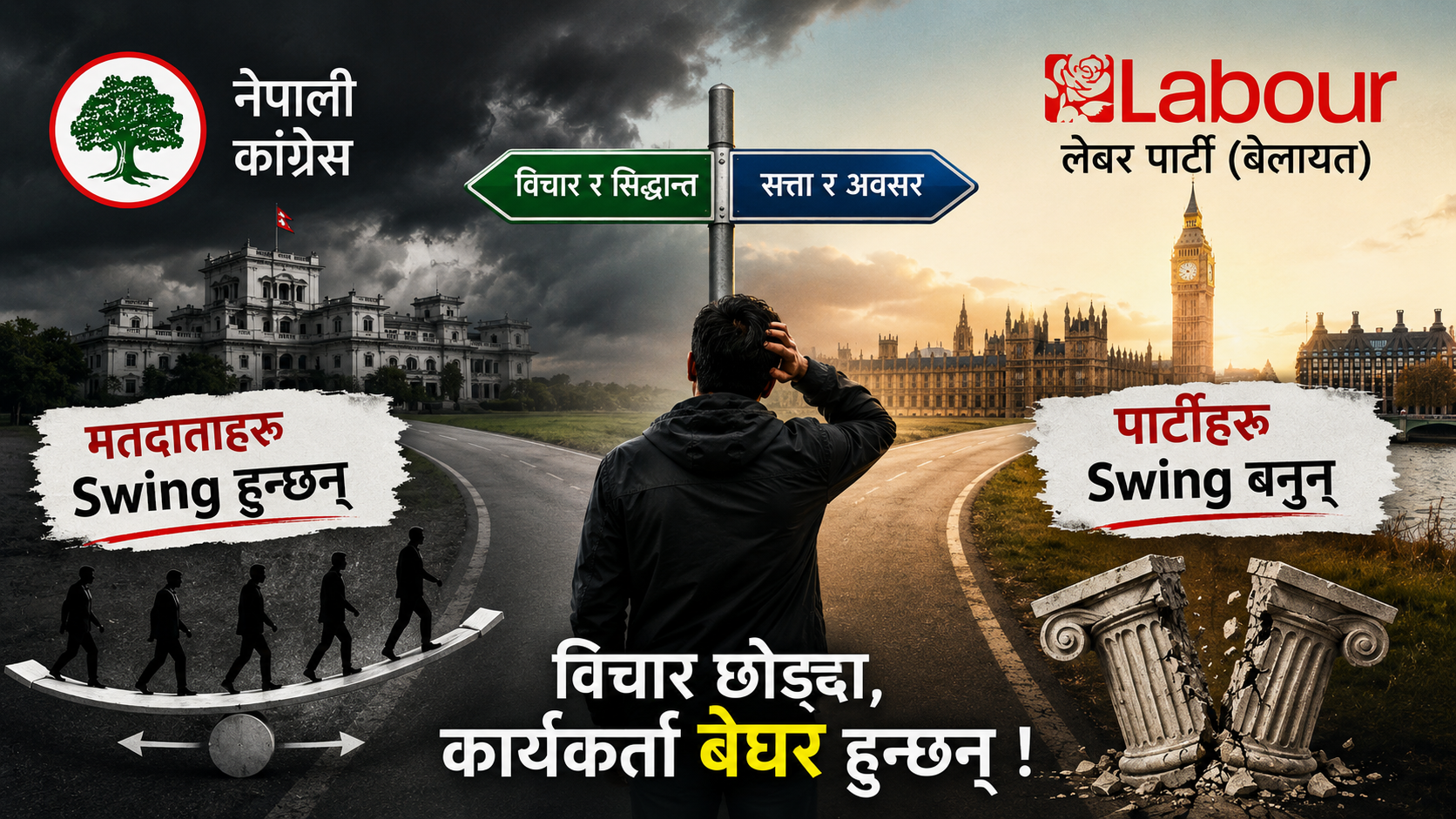
When Parties Drift, Activists Become Homeless

It is a natural process for voters to be "swing voters" during an election. However, when political parties themselves become "swing parties," it leaves those of us who choose a party based on ideology—the "non-swing" supporters—in a state of total abandonment.

In Nepal, the Nepali Congress, and in the United Kingdom, the Labour Party, have both abandoned their traditional ideological foundations. By leaning towards the Centre-Right, they have left those of us who remain committed to the Centre-Left feeling like we have neither a home nor a harbour. In Nepal’s recent elections, the Nepali Congress became so "brainwashed" by the Centre-Right narrative of figures like Arun Subedi that it did not just lose its ideological space—it allowed forces like the RSP (Rashtriya Swatantra Party) to move in and occupy that vacuum.
Similarly, here in the UK, Sir Keir Starmer’s desperate hunger for power has pushed the Labour Party away from its Centre-Left roots and towards the Right. The results of yesterday’s local elections have caused damage that mirrors the plight of the Nepali Congress.
Conclusion: Voters may be "swing voters," and that is their right. But parties should not become "swing parties." When parties deviate from their core ideologies, it is the principled activists and well-wishers who end up in a state of total disarray.
Key Terminology Used:
- Swing Voter: A voter who shifts their vote between different parties depending on the situation, rather than out of permanent ideological loyalty.
- Centre-Left/Centre-Right: Political positions representing moderate socialism/social democracy versus moderate conservatism.
- Billi-bath (बिल्लीबाठ): Translated here as "total abandonment" or "state of disarray" to reflect the feeling of being politically homeless.