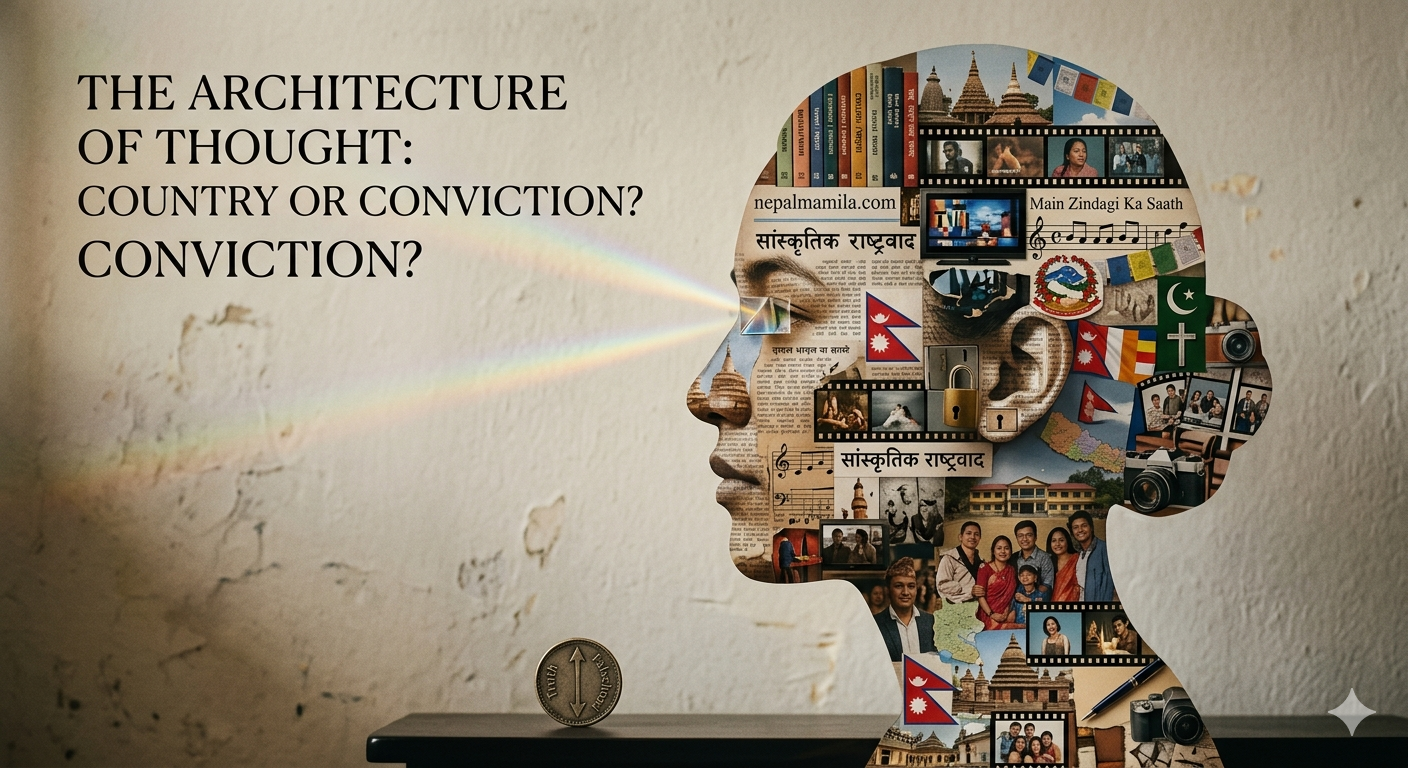
The Architecture of Thought: Country or Conviction?

Is the nation above the idea, or is the idea above the nation?
Ideologies are never absolute; they do not simply appear out of nowhere. Instead, your world-view is a slow construction, built by the era you live in, the things you witness, the stories you hear, and the life you endure. Your thoughts are the children of your environment.
They are shaped by the family that raised you, the schools and colleges that educated you, and the specific curricula you were taught. Your perspective is moulded by the friends you keep, the religion you practice, and the culture and traditions you uphold. Even the system of governance you live under, the laws of the land, and the role models you choose to follow play their part. The books and newspapers you read, the films you watch, the television channels you tune into, the music you listen to, and your deepest passions—all of these are the architects of your mind.
Ideas are neither inherently "good" nor "bad". They are simply appropriate or inappropriate depending on the time, the place, and the circumstances. Your thoughts may feel like the truth to you, just as mine do to me. But what feels like a profound truth to one may mean nothing to another. In this sense, an idea is both true and false—a single coin with two distinct faces.
While the individual and the act of thinking may be free, the thoughts themselves can never be absolute or detached from the journey that created them. Every idea is a product of what we have learned and what we have lived.