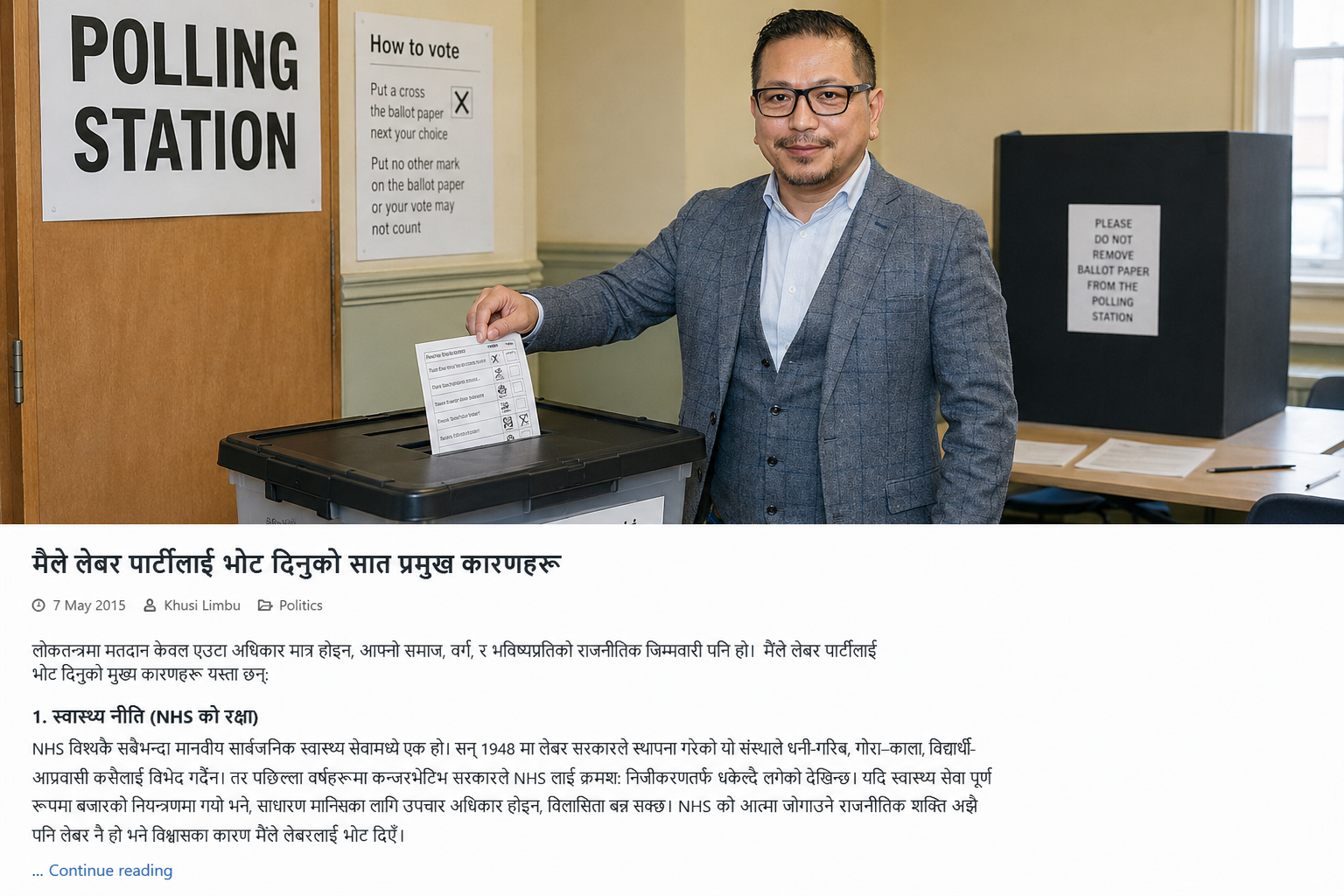
Seven Reasons Why I Voted for Labour

The Original Manifesto: Why I Stand with Labour
First published: 7 May 2015
In a democracy, voting is not merely a right; it is a political responsibility toward our society, our class, and our future. My decision to cast my vote for the Labour Party is rooted in these seven core pillars:
1. Healthcare Policy (Protecting the NHS)
The National Health Service (NHS) is one of the most compassionate public health systems in the world. Established by a Labour government in 1948, it does not discriminate between the rich and the poor, black and white, or students and immigrants.
However, in recent years, we have seen the Conservative government gradually push the NHS toward privatisation. If healthcare falls completely under market control, medical treatment for ordinary people may become a luxury rather than a right. I voted for Labour because I believe they are the only political force capable of preserving the soul of the NHS.
2. Education Policy
Higher education became significantly more expensive after the Conservative government increased university fees from £3,000 to £9,000. This shift turned universities into accessible spaces for the wealthy while creating a debt trap for the lower and middle classes.
Ordinary students are now graduating burdened by tens of thousands of pounds in debt. Labour’s policy to reduce fees and increase public investment is essential to making education accessible. That is why I supported Labour.
3. Immigration Policy
The Labour Party is generally more liberal and sensitive to human rights regarding immigration. This does not mean "open borders," but rather a perspective that does not view immigrants solely as a political "problem."
While some in our community view the Conservatives as generous due to certain Gurkha rights decisions, it is important to remember that political parties often make decisions based on electoral interests. The Conservative Party’s historical foundation lies in traditional wealth and right-wing nationalism. I believe Labour holds a stronger commitment to protecting a multicultural society.
4. Employment and Living Standards
Increasing the number of jobs is not enough; the quality of life for workers must also improve. If the wages of a cleaner, security guard, or low-income worker remain stagnant while the cost of living doubles, we must ask: Who is actually benefiting from economic growth? I do not view an economy where the rich get richer while the working class remains stagnant as a just system. I chose the party that gives a voice to the working class.
5. Welfare and Social Security
Conservatives often present cuts to social security as "fixing the economy," but the real impact falls on low-income families, people with disabilities, the elderly, students, and the sick.
There is a clear class bias when a system obsessively hunts for minor "Benefit Fraud" but fails to crack down on the billions lost to tax avoidance by the ultra-wealthy. Labour views social security not as an unnecessary expense, but as the foundation of social justice.
6. Taxation Policy
A tax system is more than a way to raise revenue; it is a measure of a society's fairness. Providing minor relief to low-income earners while granting massive tax breaks to the wealthy is not economic equality.
A civilised society must include the vulnerable, the unemployed, students, immigrants, and the elderly as equal stakeholders. This country does not belong only to the successful and the wealthy—it belongs to everyone.
7. Ultimately—Who does Labour represent?
Historically, the Labour Party was established as the political voice of the working class, labourers, low-income families, immigrants, and marginalised communities.
I view politics not through the lens of individual success or nationalist slogans, but through the condition of the weakest members of our society. That is why I voted for the Labour Party.
Author’s Closing Note: If these arguments resonate with you, please decide according to your own conscience. The greatest power in a democracy is the conscious vote of its citizens.