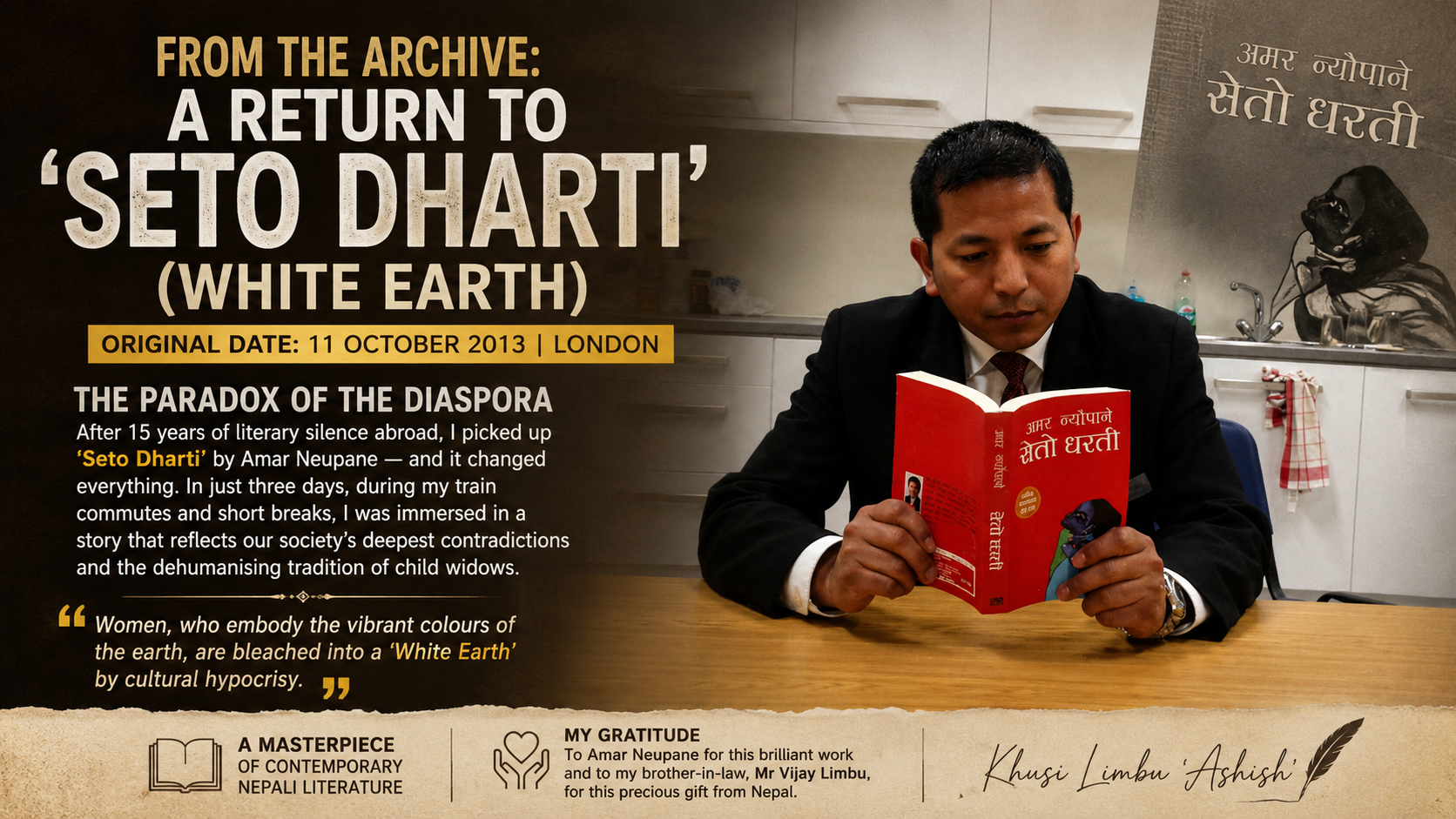
From the Archive: A Return to 'Seto Dharti' (White Earth)

Original Date: 11 October 2013 | London
The Paradox of the Diaspora
For nearly a decade and a half, I lived in a self-imposed literary silence. Driven by the constant internal pressure to improve my English and consumed by the relentless pace of life abroad, I had stopped reading Nepali literature. Yet, after fifteen years, I found myself in a strange limbo: I hadn't quite mastered the English language, nor had I stayed in touch with the evolving world of Nepali fiction.
That changed when I finally picked up 'Seto Dharti' (White Earth), the Madan Puraskar-winning novel by the celebrated young author Amar Neupane.
A Mirror to a Dehumanising Tradition
Written in a beautifully lucid and artistic style, Seto Dharti is a profound exploration of the life of a marginalised child widow. The narrative spans an entire era—from 1990 BS (1933 AD) to the present day—tracing the life of a girl forced into marriage at the age of seven, only to be widowed by nine.
Neupane masterfully captures how a young woman, full of life, is forced into a world of white robes and social isolation. The title itself is a sharp critique of our traditional society: how women, who embody the vibrant colours of the earth, are bleached into a "White Earth" (Seto Dharti) by cultural hypocrisy.
Reading Between the Commutes
Back in my student days in Nepal, when I studied Major Nepali, it would take me weeks to finish slender novels like Basain or Maitighar. Yet, to my surprise, I finished this thick volume in just three days. I read it on the trains during my commute to work and in the short breaks in between.
The prose is so lyrical, moving, and evocative that I didn't even notice the time passing. It is a masterpiece of contemporary Nepali literature that offers a new dimension to our storytelling.
Gratitude
My heartfelt thanks go to the creator, Amar Neupane, for such a high-calibre work, and to my dear brother-in-law, Mr Vijay Limbu, who sent this book to me from Nepal as a gift of memory.